artisti

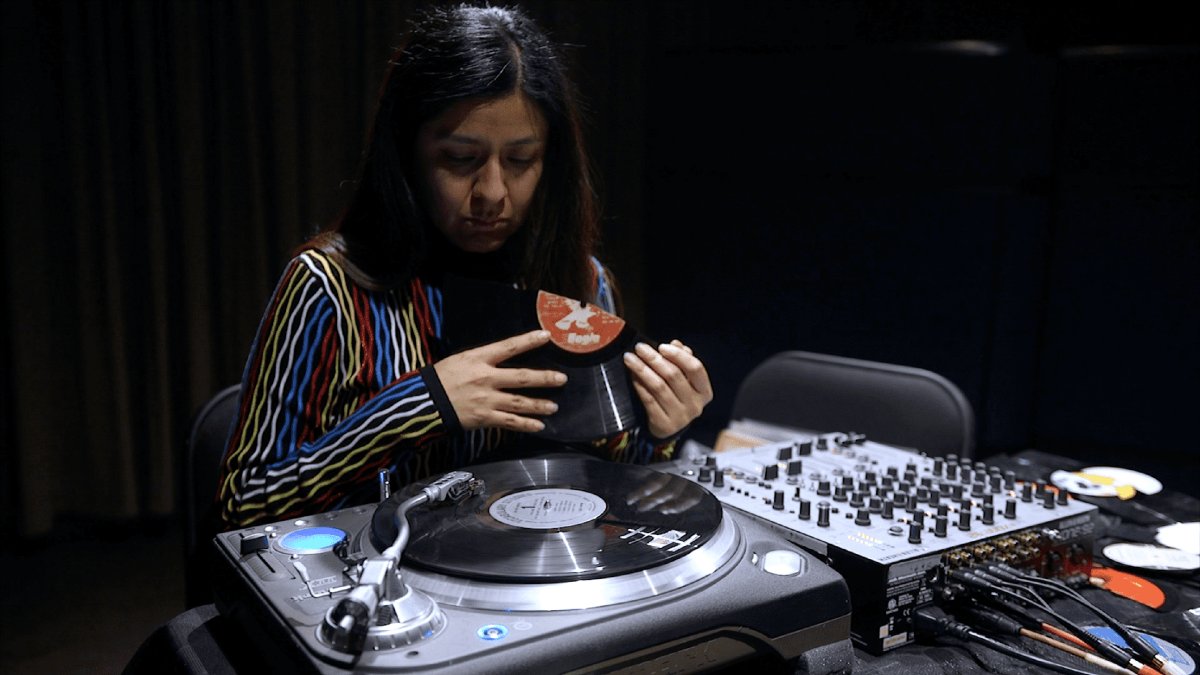
Maria Chavez
Maria Chavez, nata a Lima e residente a New York, è una sound artist e DJ affermatasi come ‘abstract turntablist’. Coincidenza, caso ed errore sono gli elementi ricorrenti del suo lavoro che attraversa diversi media e forme di espressione: sound performance, sculture, installazioni multicanale, libri-oggetto. Il suo approccio affonda le radici nel Deep Listening, una forma di ascolto corporeo sviluppata da Pauline Oliveros, anche sua mentore. Maria Chavez è l'unica turntablist al mondo ad utilizzare una speciale puntina per giradischi, la RAKE Double Needle, inventata da Randal C. Sanden Jr nel 2001 per la comunità dello scratch hip hop. Questo dispositivo accoppia due puntine su un’unica testina, consentendo di leggere simultaneamente due segmenti diversi di un singolo disco. Grazie alla capacità di Chavez di creare esperienze sonore effettivamente irripetibili, a partire da frammenti di dischi rotti, ogni performance è un viaggio enigmatico attraverso il suono. Il suo lavoro è stato presentato e supportato da istituzioni internazionali negli ultimi decenni, tra cui Rewire Festival, Counterflows Festival, Donau Festival, MoMA PS1, The Getty, DOCUMENTA 14, la JUDD Foundation, Cambridge University Press e molte altre. Ha pubblicato su diversi supporti, non solo vinile, assieme a Sandy Ewen per OrbTapes, e Jordi Wheeler per l'etichetta Takuroku, assieme a Lucas Gorham per Ratskin Records, e un flexi disc con Devin Kenny per Ballastnvp. Il suo album Maria Chavez PLAYS Stefan Goldmann’s Ghost hemiola, una meta-indagine sul vinile, è un omaggio al supporto stesso. Il suo libro Of Technique: Chance Procedures on Turntable (2012) è considerato una risorsa accademica essenziale per lo studio del turntablism, oltre che a rappresentare un testo fondamentale per una nuova generazione di soundmakers e DJs. Il suo ultimo saggio sulle pratiche multimediali, vuole essere un incoraggiamento alla neuroplasticità nella società contemporanea ed è distribuito da E-Flux Journal e dal Guggenheim Museum.
Maria Chavez, born in Lima, Peru, and based in New York City, is a sound artist, DJ, and curator, best known as an abstract turntablist. Coincidence, chance and failures are recurring in her work across mediums, including improvised performance,sonic sculpture, visual art,book objects and an extensive history with multi-channel installation.Her multimedia practice is profoundly expansive and responsive, emphasizing attention to context. Her approach is rooted in Deep Listening, a form of embodied listening developed by her late mentor Pauline Oliveros. Maria Chavez is the only turntablist in the world who performs with a rare needle known as the RAKE Double Needle, invented by DJ Randal C. Sanden Jr. in the early 2000s for the scratch hip-hop community. This special device contains two needles on one head, allowing it to read two different segments of a single record at the same time. Paired with her inimitable ability to create sonic experiences from shards of broken records, each performance is an enigmatic journey through sound. Her work has been featured and supported by international institutions over the past decades including Rewire Festival, Counterflows Festival, Donau Festival, MoMA PS1, The Getty, DOCUMENTA 14, the JUDD Foundation, Cambridge University Press and many more. She released recordings with Sandy Ewen via OrbTapes, and with Jordi Wheeler via Takuroku label, a cassette with collaborator Lucas Gorham via Ratskin Records, a flexi disc with Devin Kenny via Ballastnvp. Her album Maria Chavez PLAYS Stefan Goldmann’s Ghost hemiola, an investigation of the unobstructed vinyl medium,is an homage tothe medium itself. Chavez’s 2012 book Of Technique: Chance Procedures on Turntable has garnered a reputation as both an academic resource on turntablism and a foundational text for a new generation of turntablists. Her latest essay on how multi-media installation practices can be considered part of encouraging neuroplasticity in society is available via E-Flux Journal and the Guggenheim Museum.